Women
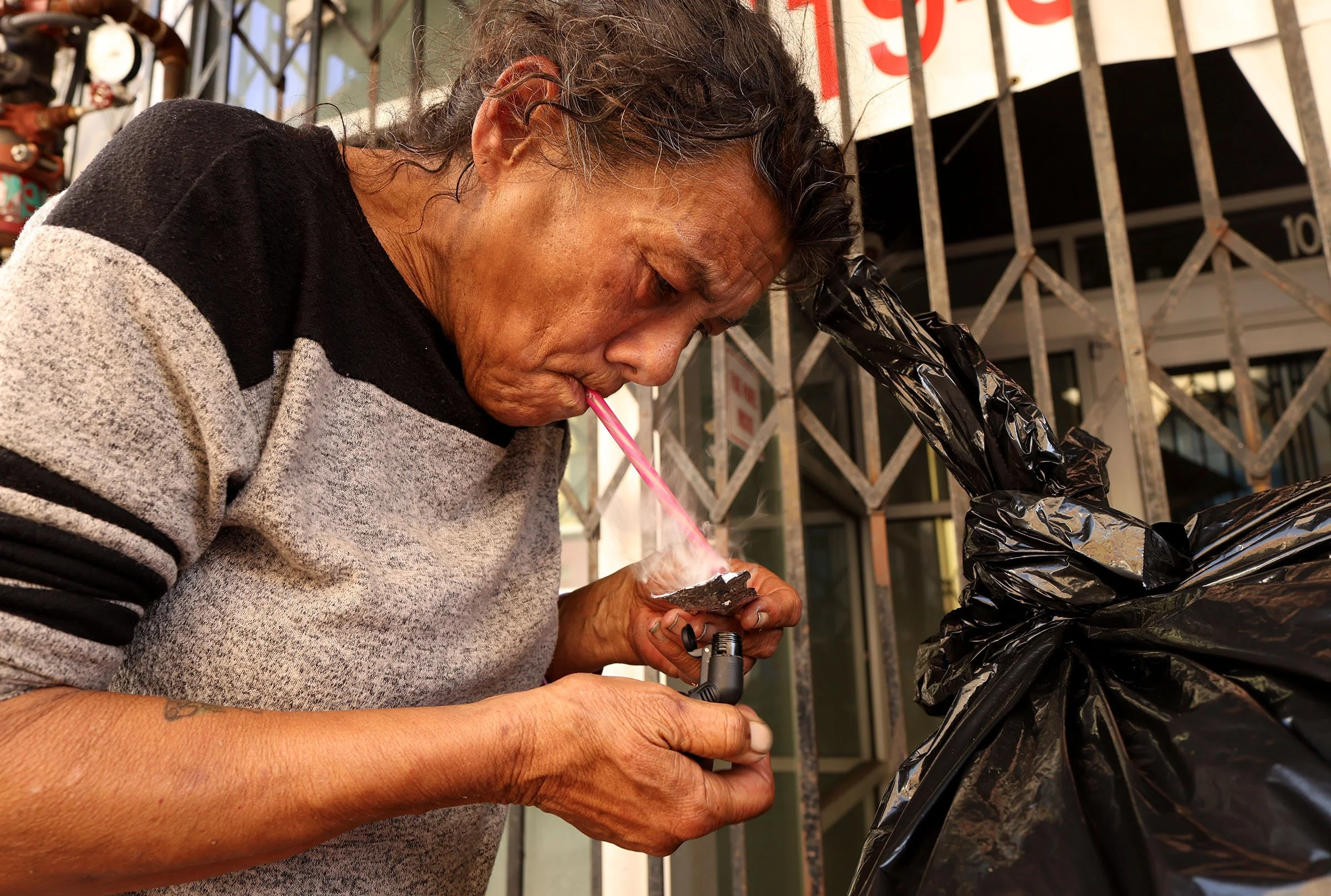
Kelly, 63, has been homeless for about three years. She admits she didn’t have the best role models growing up, which explains a cycle of abusive marriages, having children at a young age, and falling in and out of drug addiction. But she has also been able to step back and see the big picture just in time to pull herself back from the brink - to leave a failing marriage, to find a sober living program, to associate herself with people on the street who feel safe. As she gets older, however, the physical and mental health issues associated with hard living are catching up with her. She knows how to access survival resources, but could use a place of her own at this point. In the meantime, she is quick to share a windfall of food, money, even drugs with someone else on the street whose need appears to be greater than her own.
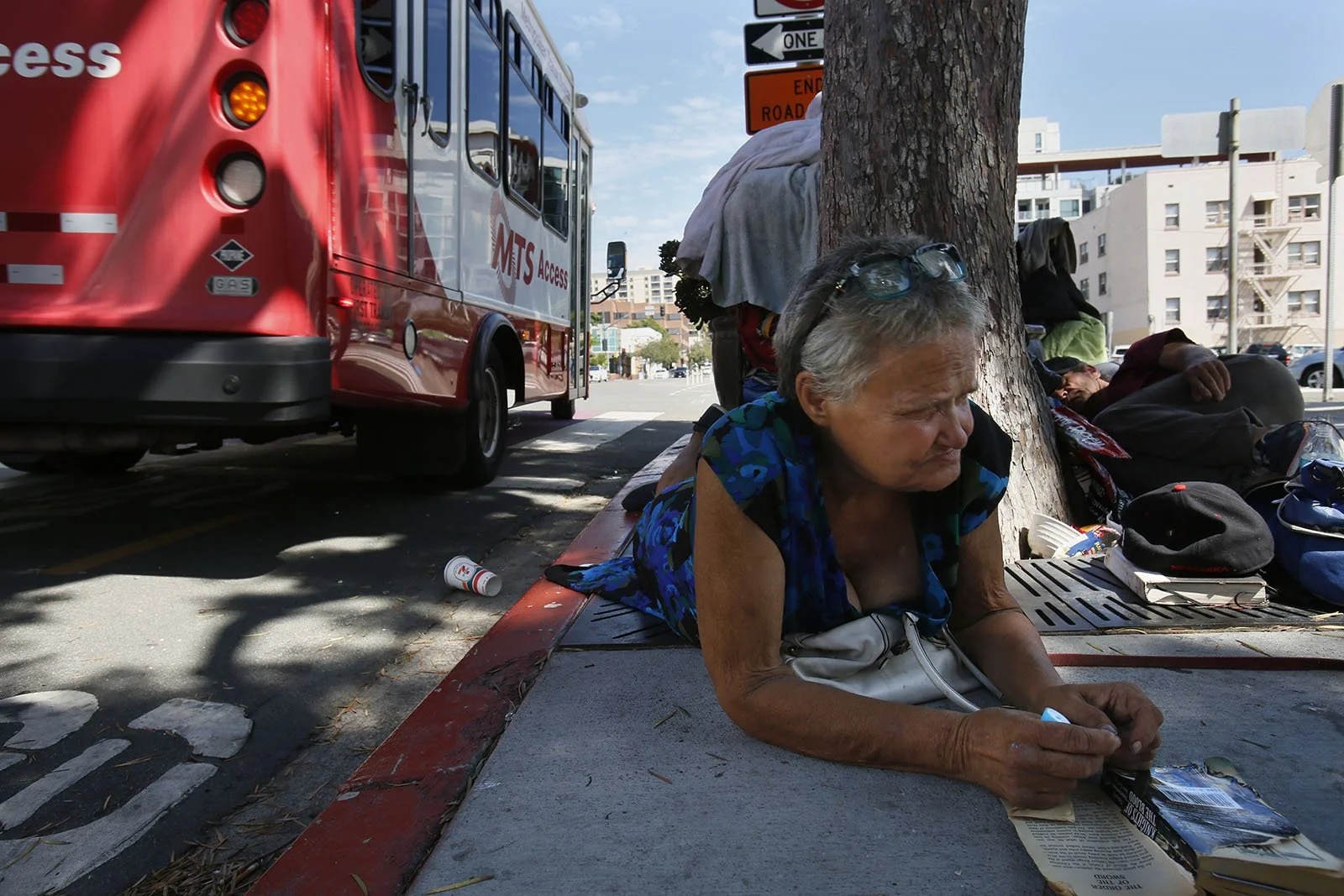
Jenny is always stylishly dressed. She never has many belongings with her, but always has her curly haired schnauzer Gizmo trotting along beside at the end of a rope leash. She laments the short-sightedness of city government, taking away vital public showers and toilets with hand washing stations. “If Waterman Dave was still around, those water stations would still be here,” she said. Now that her husband of many years has passed away, she has to contend with being a woman alone on the street. Every time she finds a place that feels safe, the city’s Clean and Safe squad tel her to move. She has tried the O Lot and B Lot tent cities, but the rats and bugs make those sites unlivable. She would love to get a bed in the Alpha tent, or better yet, something permanent. She just had her 67th birthday and admits she’s tired of sleeping on the street. “I need permanent housing,” she said. “I don’t want to die in my car like my old man.”
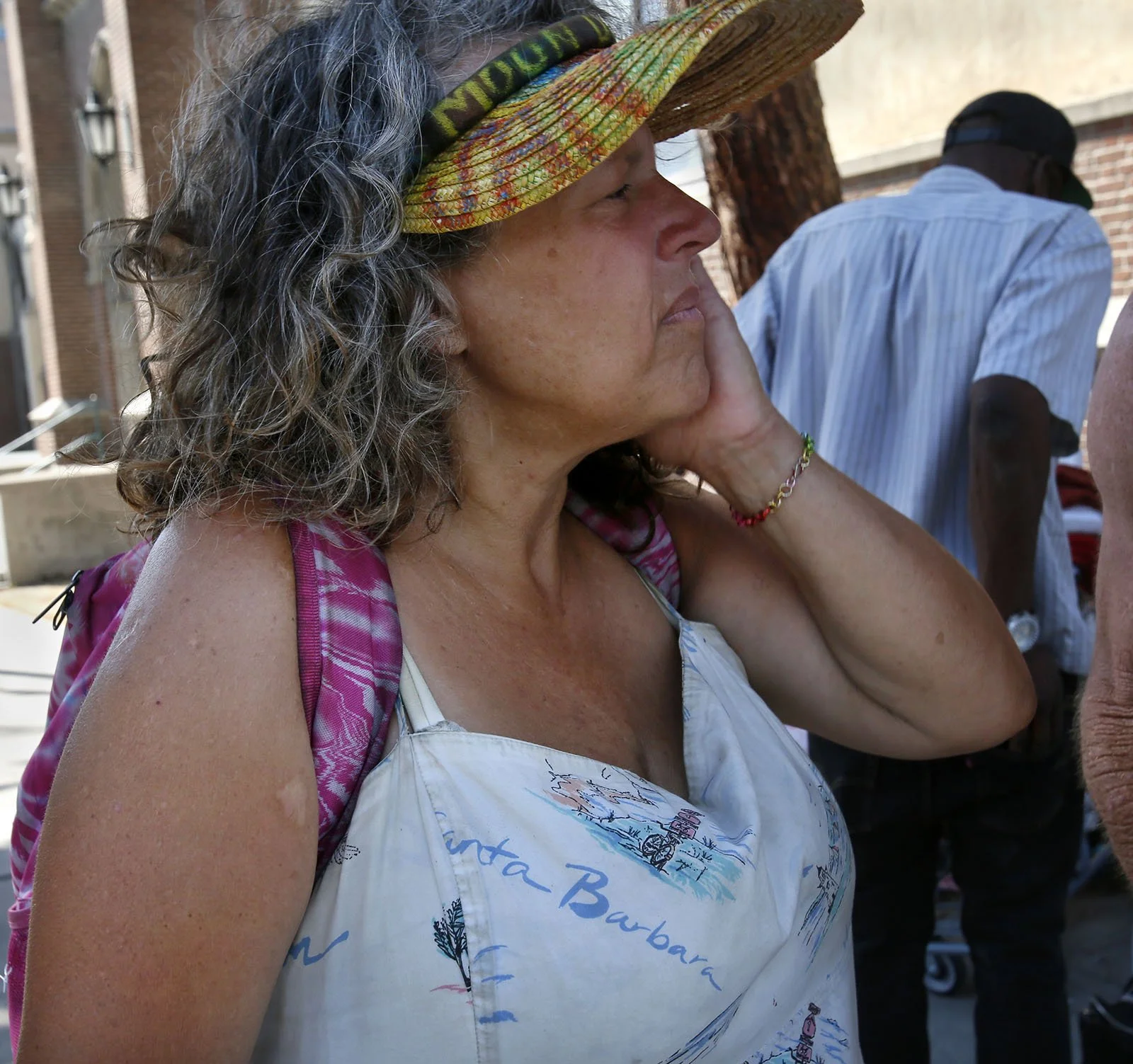
Kim has two dresses. She scrubs them clean until they fall apart. She also has a gym membership and “spends forever in there cleaning.” She wishes she could do a yoga class, but her shoes are filthy and she’s too embarrassed to put her shoes on a yoga mat. Homeless for the last 15 years, Kim, 55, suffered a traumatic brain injury some 25 years ago. “I lost my respiratory therapist license because I cracked my head open on a dock doing back flips. I was an avid cyclist. I took a header. That’s when I started having narcolepsy. I couldn’t wake up.” That narcolepsy can happen at any moment and last for any length of time, after which she wakes up having been robbed and assaulted. She therefore chooses her friends carefully. “I need a home. Now, not four years from now,” she said. “I am viable, I can still work. Homelessness is a disability. Homelessness is a sin. People should be working harder to help people off the street.”
Men
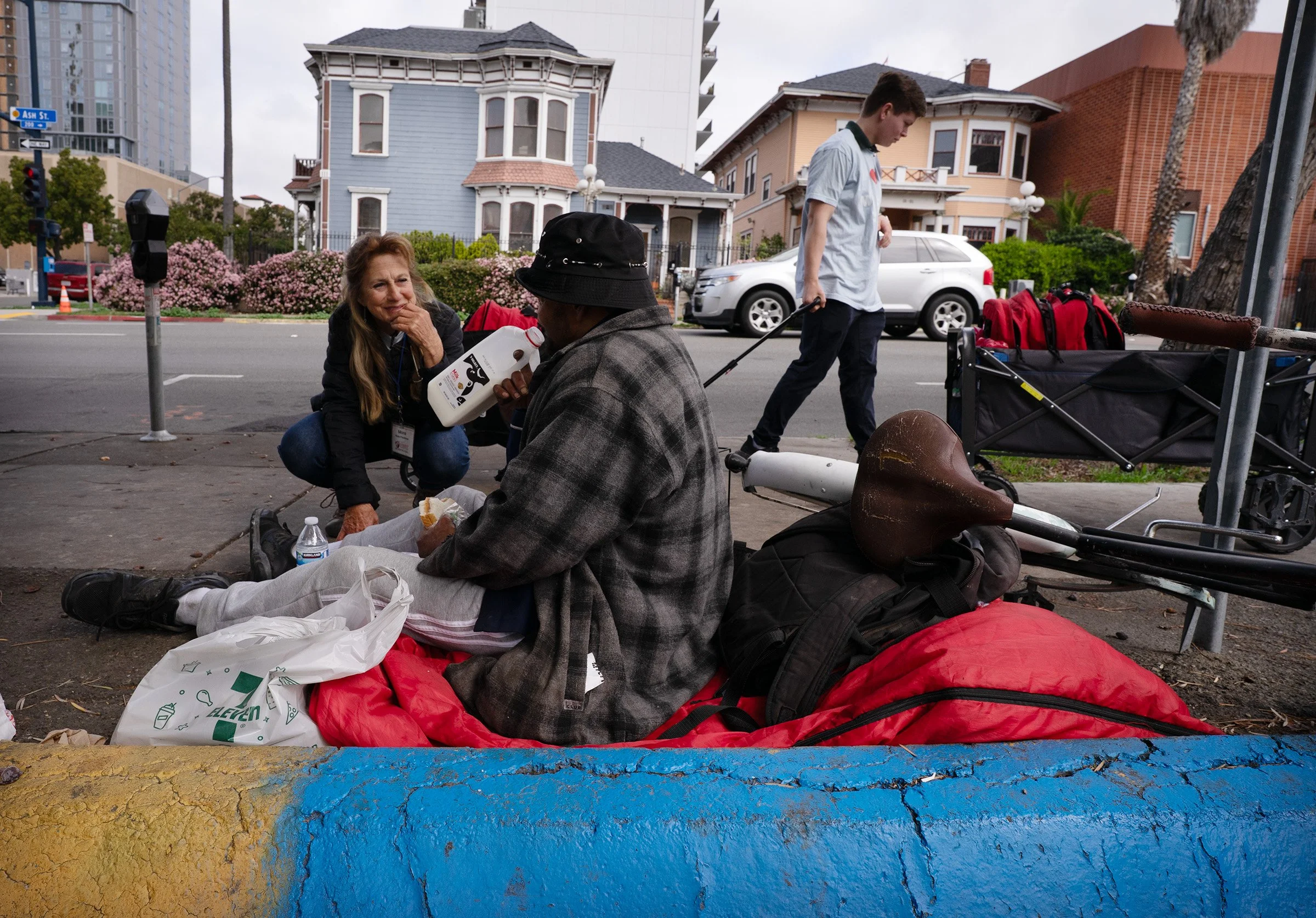
Once a month, a team of volunteer healthcare providers - professionals and student volunteers - form the Street Corner Care (SCC) outreach team, pulling carts overflowing with water, snacks, hygiene products, and socks on a meandering path towards the heart of America’s Finest City. The people they encounter need a kind words as much as any sustenance or wound care. The mission is connection, building trust, and inviting people to stop in on Sunday afternoons for a meal, clothing and more organized medical attention operated by the Ladle Fellowship at the First Presbyterian Church. The SCC has exponentially grown its volunteer force since its inception in 2017 as a response to the deadly Hep A outbreak on San Diego’s streets. While students learn an aspect of care that doesn’t come from books, the clients can always count on a year-round spirit of giving.

Victor, 57, has little sympathy for homeless individuals who say they can’t get the help they need. “People out here who aren’t even trying to get into housing or a program or whatever, are just lazy,” he said. He pointed out that anything anyone needs is out there, free. Before he was homeless, Victor said, he worked at US Bank as a loan officer. A painful divorce pushed him in the wrong direction. He said it was stressful to go from seeing his daughters every day, to only seeing them every other week. He realizes now that he lost his real purpose in life - his family. A resourceful person, Victor knows where to get food, clothes or a shower on any given day of the week. Eventually he will move indoors and get a job because his body is feeling the wear and tear of sleeping on concrete. For now, he is traveling light, staying away from certain parts of town, and saying yes when outreach or nonprofit groups offer services.
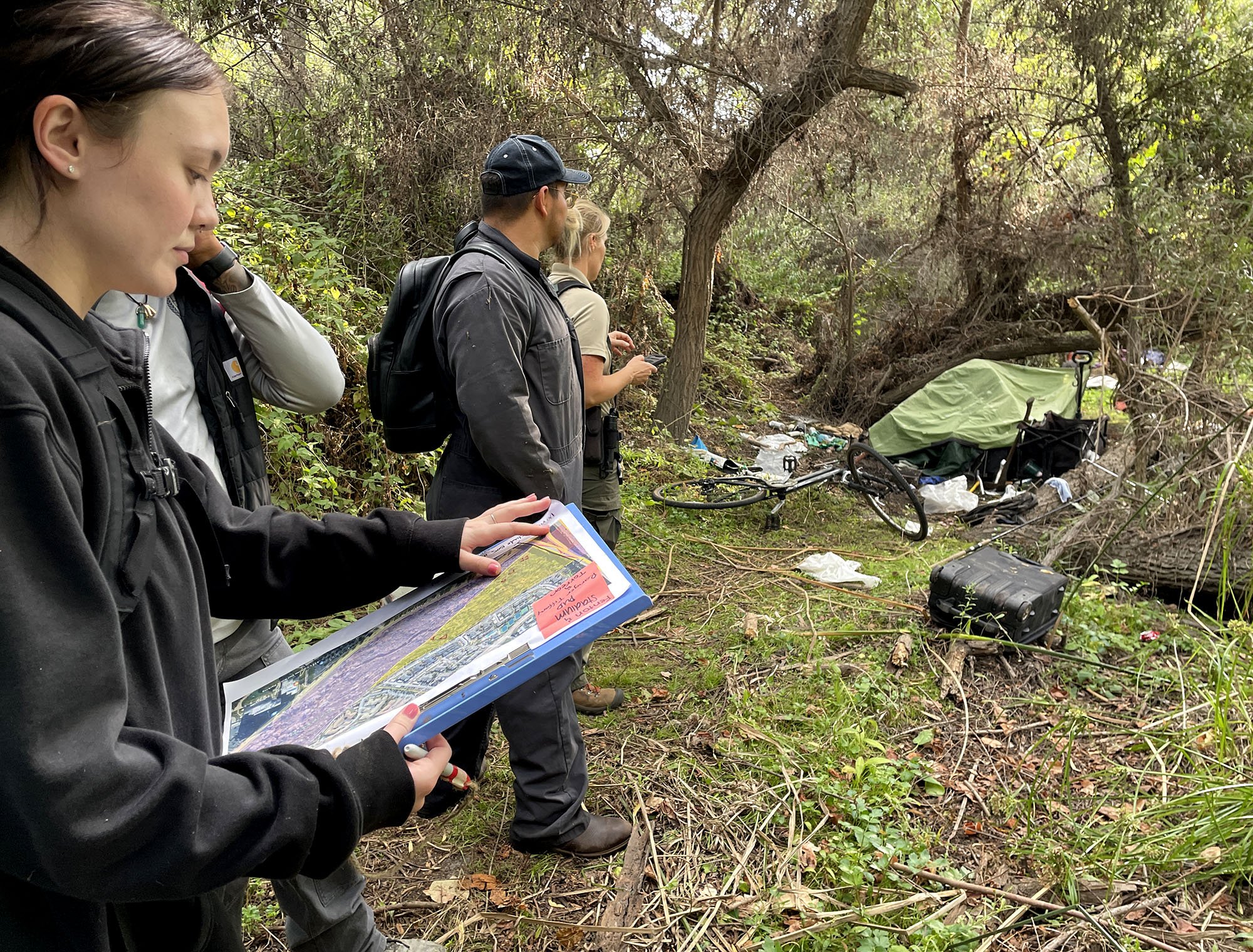
Some 71 volunteers, six PATH outreach workers, four SD Park Rangers and one state Assembly member trudged through dense growth and spiderwebs at 6 a.m. to count tents, and to offer people hygiene kits, water, and connection to services. This quiet wave of volunteers spent four days (September 25-28) conducting field surveys for the fall census of unhoused individuals living in the riverbed.In total, 323 people were counted, reflecting a 14.9% decrease since the spring census count (281). Organizers pointed out that it is important to consider that in the spring there are less people camping in the river because of the rain and the height of the river itself. The overall number is down by 100 people from fall of 2024 (423).
Seniors
Kelly, 63, has been homeless for about three years. She admits she didn’t have the best role models growing up, which explains a cycle of abusive marriages, having children at a young age, and falling in and out of drug addiction. But she has also been able to step back and see the big picture just in time to pull herself back from the brink - to leave a failing marriage, to find a sober living program, to associate herself with people on the street who feel safe. As she gets older, however, the physical and mental health issues associated with hard living are catching up with her. She knows how to access survival resources, but could use a place of her own at this point. In the meantime, she is quick to share a windfall of food, money, even drugs with someone else on the street whose need appears to be greater than her own.
Jenny is always stylishly dressed. She never has many belongings with her, but always has her curly haired schnauzer Gizmo trotting along beside at the end of a rope leash. She laments the short-sightedness of city government, taking away vital public showers and toilets with hand washing stations. “If Waterman Dave was still around, those water stations would still be here,” she said. Now that her husband of many years has passed away, she has to contend with being a woman alone on the street. Every time she finds a place that feels safe, the city’s Clean and Safe squad tel her to move. She has tried the O Lot and B Lot tent cities, but the rats and bugs make those sites unlivable. She would love to get a bed in the Alpha tent, or better yet, something permanent. She just had her 67th birthday and admits she’s tired of sleeping on the street. “I need permanent housing,” she said. “I don’t want to die in my car like my old man.”
Once a month, a team of volunteer healthcare providers - professionals and student volunteers - form the Street Corner Care (SCC) outreach team, pulling carts overflowing with water, snacks, hygiene products, and socks on a meandering path towards the heart of America’s Finest City. The people they encounter need a kind words as much as any sustenance or wound care. The mission is connection, building trust, and inviting people to stop in on Sunday afternoons for a meal, clothing and more organized medical attention operated by the Ladle Fellowship at the First Presbyterian Church. The SCC has exponentially grown its volunteer force since its inception in 2017 as a response to the deadly Hep A outbreak on San Diego’s streets. While students learn an aspect of care that doesn’t come from books, the clients can always count on a year-round spirit of giving.
VETERANS
Once a month, a team of volunteer healthcare providers - professionals and student volunteers - form the Street Corner Care (SCC) outreach team, pulling carts overflowing with water, snacks, hygiene products, and socks on a meandering path towards the heart of America’s Finest City. The people they encounter need a kind words as much as any sustenance or wound care. The mission is connection, building trust, and inviting people to stop in on Sunday afternoons for a meal, clothing and more organized medical attention operated by the Ladle Fellowship at the First Presbyterian Church. The SCC has exponentially grown its volunteer force since its inception in 2017 as a response to the deadly Hep A outbreak on San Diego’s streets. While students learn an aspect of care that doesn’t come from books, the clients can always count on a year-round spirit of giving.
Some 71 volunteers, six PATH outreach workers, four SD Park Rangers and one state Assembly member trudged through dense growth and spiderwebs at 6 a.m. to count tents, and to offer people hygiene kits, water, and connection to services. This quiet wave of volunteers spent four days (September 25-28) conducting field surveys for the fall census of unhoused individuals living in the riverbed.In total, 323 people were counted, reflecting a 14.9% decrease since the spring census count (281). Organizers pointed out that it is important to consider that in the spring there are less people camping in the river because of the rain and the height of the river itself. The overall number is down by 100 people from fall of 2024 (423).

Quietly sipping hot coffee and reveling in a fresh bear claw pastry, Mike waited his turn to get a hot shower courtesy of the portable shower unit parked behind St. Paul’s Church, courtesy of the Voices of Our City Choir. The 29-year-old Ohio native carries an umbrella to ward off the coming rain. He said it was a lot easier to deal with than the blizzards of snow he grew tired of in Ohio and then later in upstate New York. All of that was in sharp contrast to the heat he endured on his multiple tours in Iraq and Afghanistan while serving in the U.S. Army as a cook.

Beginning with the early days when San Diego’s Voices of Our City Choir co-creator singer-songwriter Steph Johnson walked the streets offering oranges and a song to unsheltered members of the community, this unique coming together of souls has changed the lives of those who participate as well as those who hear them sing.

Ian, 41, was born in Ohio, but moved to San Diego when he was four. His father was in the navy and his mother was a registered nurse. He went to Spring Valley High School - a stand out water polo player. After his parents divorced and his mother remarried, he was abused by his step-father who threatened to have his two sons from a previous marriage beat him up if he said anything. A string of bad luck before, during and after his service in the Air Force finally broke his spirit. He and his dog Oreo make do on the streets.

Randy, 63, was born and raised in San Diego, graduating from Sweetwater High with a love for anything to do with mathematics. He father, a veteran, convinced him to join the military after graduation. A long-haired surfer, Randy opted for the Merchant Marines, since they promised he would be sent to Hawaii. He was in Hawaii for two days before his unit was shipped to Saigon. As long as he has his dog Bullet with him, he is just fine, he said. Currently his is living in a downtown SRO, hoping to get into housing through the VASH program.

Born in Denver, Colorado, Benito, 59, was one of 11 kids. The oldest brother, a Marine, died in Vietnam. He also has a brother in the Navy. Benito joined the Army. When on patrol in Iraq, a bullet sent a chip of concrete flying that broke his collarbone. That injury brought him home. His second wife died of a heroin overdose when their baby was six months old. That drove him into a depression that was hard to crawl out of, but he did. That lasted until light from a welding arc affected his vision, and he ended up an alcoholic and on the street again.

An interfaith memorial service was held for Randy Ferris, 65, Walter Jones, 61, and Rodney Diffendal, the three homeless men who were killed by a drunk driver on the morning of March 15, 2020 as they were resting in their tents on B Street near San Diego City College. Two men in wheelchairs who were injured during the same incident, Duane and Jesse, sat solemnly together during the service. The tunnel where it happened is still covered in chalk dedications to the fallen.

The local Harm Reduction Coalition holds street medicine outreach events despite looming rain clouds and a cold wind. They offer packages of fresh syringes, backpacks, clothing, food and Naloxene (Narcan). The Harm Reduction Coalition began operation in October 2022 following approval from the California Department of Public Health office of AIDS. According to the group’s executive director Tara Stamos-Buesig, they have also been doing syringe service outreach three days a week. San Diego County Board of Supervisors voted in favor of developing a needle exchange program, essentially repealing the ban on such programs enacted in 1997.

Michael Connelly, 62, grew up in Tucson, AZ. and joined the army right out of high school. He was a field medic but realized pretty quickly he couldn’t stand the sight of blood. His original goal had been to work as an operating room technician. At the age of 18, however, the idea of knowing and organizing all those tools when someone’s life was at stake, was a bit daunting. Red came out to San Diego in 1980, worked off and on at odd jobs, got married in 1988, has four kids, then got divorced in 1998. “After the divorce I ended up out on the streets, and got into the drugs and things. I spent the next 20 years out here doing drugs and ruining my life.”
YOUTH
Once a month, a team of volunteer healthcare providers - professionals and student volunteers - form the Street Corner Care (SCC) outreach team, pulling carts overflowing with water, snacks, hygiene products, and socks on a meandering path towards the heart of America’s Finest City. The people they encounter need a kind words as much as any sustenance or wound care. The mission is connection, building trust, and inviting people to stop in on Sunday afternoons for a meal, clothing and more organized medical attention operated by the Ladle Fellowship at the First Presbyterian Church. The SCC has exponentially grown its volunteer force since its inception in 2017 as a response to the deadly Hep A outbreak on San Diego’s streets. While students learn an aspect of care that doesn’t come from books, the clients can always count on a year-round spirit of giving.

At an intersection where most drivers roll up their windows and lock their doors, Sadri, 23, bounces out of the car and pops the trunk. Two men who had been quietly smoking cigarettes in the shade across the street immediately gravitate towards Mesean Sadri and his open trunk. Slowly, others leave the shade to get in line for a slice, a bottle of water and a kind word. “I thought I was already empathetic,” Sadri said. “But being out here made me a lot more empathetic, a lot more understanding, a lot more educated.”

Serenity Rubalcaba, 20, takes her time gathering belongings and carrying them from one side of the street to the other, stepping over the trolley tracks that run down the median of Commercial Avenue in San Diego’s East Village. The sidewalks are getting hotter quickly with the summer’s first blistering heat wave. A San Diego native, she attended Clairemont High School, leaving just five credits shy of her diploma. The insecurity of being bounced around foster care homes and juvenile hall made it difficult to concentrate on her studies. And then there’s her daughter.

Art gives our spirits a chance to soar, to reflect on and reframe the situations we are dealing with. Everywhere I meet up with individuals experiencing homelessness, I discover artists - painters, musicians, crafters of jewelry or pottery or textile arts, singers, poets, and sketch artists. It speaks to the perseverance of the soul and lifts up the creative voice. Here are some of the artists I photographed that ended up featured in San Diego Magazine.
Beginning with the early days when San Diego’s Voices of Our City Choir co-creator singer-songwriter Steph Johnson walked the streets offering oranges and a song to unsheltered members of the community, this unique coming together of souls has changed the lives of those who participate as well as those who hear them sing.

Tabor Wright, 30, is proud of being clean and sober. He was born in Southwest Colorado. When his father died in 2015 however, Tabor started shooting heroin. He came out to San Diego to get away from it all and entered a sober living home. He lasted only four days there because he felt like he was being judged for being gay by the Christians who ran the place. Now, however, he is worried that when he leaves the sober living place he is at now, without an income, he may end up homeless again.
The local Harm Reduction Coalition holds street medicine outreach events despite looming rain clouds and a cold wind. They offer packages of fresh syringes, backpacks, clothing, food and Naloxene (Narcan). The Harm Reduction Coalition began operation in October 2022 following approval from the California Department of Public Health office of AIDS. According to the group’s executive director Tara Stamos-Buesig, they have also been doing syringe service outreach three days a week. San Diego County Board of Supervisors voted in favor of developing a needle exchange program, essentially repealing the ban on such programs enacted in 1997.

When the pandemic lockdown restrictions were first enacted in March, Rose, 21, and her boyfriend were suddenly locked out of the park they called home. The worst part was not being able to shower for long periods of time. If you were getting pretty ripe, and the bathrooms were open, you could scare up a bird bath type of washing. Or, if you had a pair of pliers, you could open up any random water spigot.

Tito is used to staying in the shadows, or with family or friends until he wears out his welcome. It’s a routine that was embedded into his lifestyle at an early age. He was born in Oregon, but his mother ended up homeless in San Diego, living in a tent on the street when he was still a baby. Once his mother found work they were able to secure housing. “Southeast raised me real hard,” he said. His goal is to get his GED and find a way to make a sustainable income. “This life is relentless,” he said. “It’s horrible to be homeless.”

Tiffany wants her child back. After a life in and out of foster care herself, she doesn’t want the baby that was taken from her six months ago to grow up with the same experiences she endured. A ward of the state till she was age 22, Tiffany struggled with mental health issues, addiction and homelessness. After having six other children, three of whom died either in childbirth or soon after, she is committed to creating a stable situation for herself, get an education, and find a way to build a day center for homeless youth.