Kelly
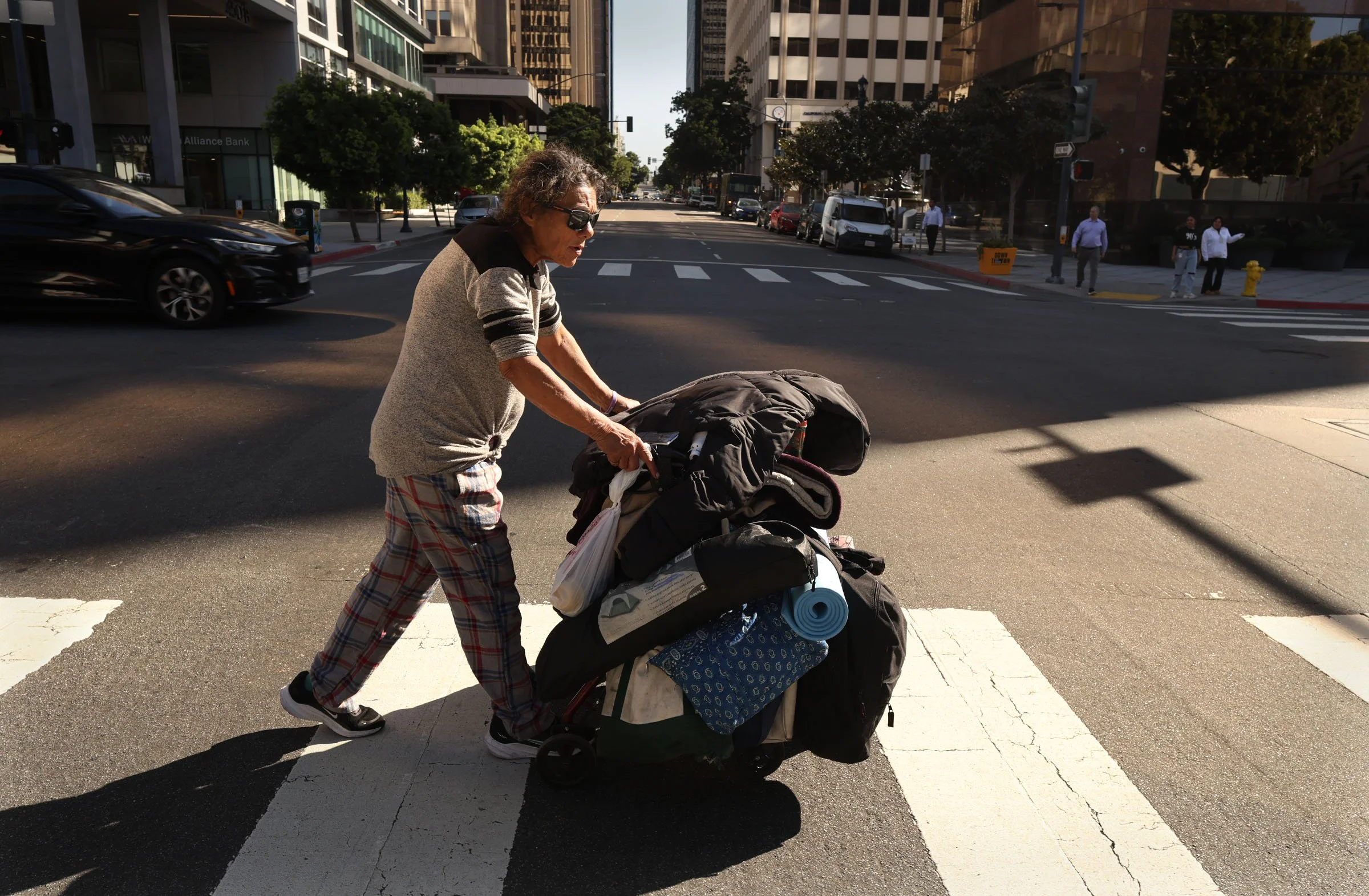
Kelly, 63, has been homeless for three years. She was living in LA from age 2 to age 10. Her dad was mean alcoholic, which caused the family to fall apart. Her mother got fed up with his drinking and womanizing, so she left him. “That was the best year of my life,” Kelly said. But her mother eventually let him come back. He knocked Kelly out one day when he was drunk, then threw her out of the house. So at age 15 Kelly went to live with a boyfriend, got pregnant, married, and moved to Texas where her husband’s folks lived. “The town was a KKK town,” she said. “No Black people were allowed there. Vidor, Texas; look it up.” Her husband eventually missed the surf in San Diego, so despite earning a good living in the Texas oil fields, they moved back to San Diego. She had her second son when she was 17, her third son at age 18, and Kelly’s daughter was born when she was 25. She and her husband continued to have a tumultuous relationship. He was violent and abusive and eventually was killed in a fight. Kelly said her second husband molested her daughter and went to prison for it.
In 2001 Kelly decided she had enough of drinking and drugs in her life. With the help of Alcoholics Anonymous she got sober. She and her third husband grew apart since he wouldn’t give up smoking pot. “It makes you have no ambition, pot does. But he was good to me,” Kelly said. “There were all these teenagers around. Everyone got high and drank (including the kids) but I jumped into AA with both feet.”
She split from that home life and reconnected with an old flame. He wasn’t exactly living clean either, so Kelly found herself playing the same old tune - “I guess I had a type,” she laughed. At one point everyone was in recovery at the same time - Kelly, her husband, and all the kids. Once again, Kelly was able to step back and see the big picture, extracting herself from a harmful situation. “I finally matured, and got comfortable with being just me. I don’t need someone to complete me.” Disconnecting from a partner meant she was on her own as far as earning a living and accessing resources. Her son Jacob was living homeless in downtown San Diego at the time, so she knew that was the place she would find the most resources. Unfortunately, her son ended up getting beat up and left for dead in a ditch. He suffered traumatic brain injuries to the extent he has very little memory and is a permanent resident at an assisted living facility.
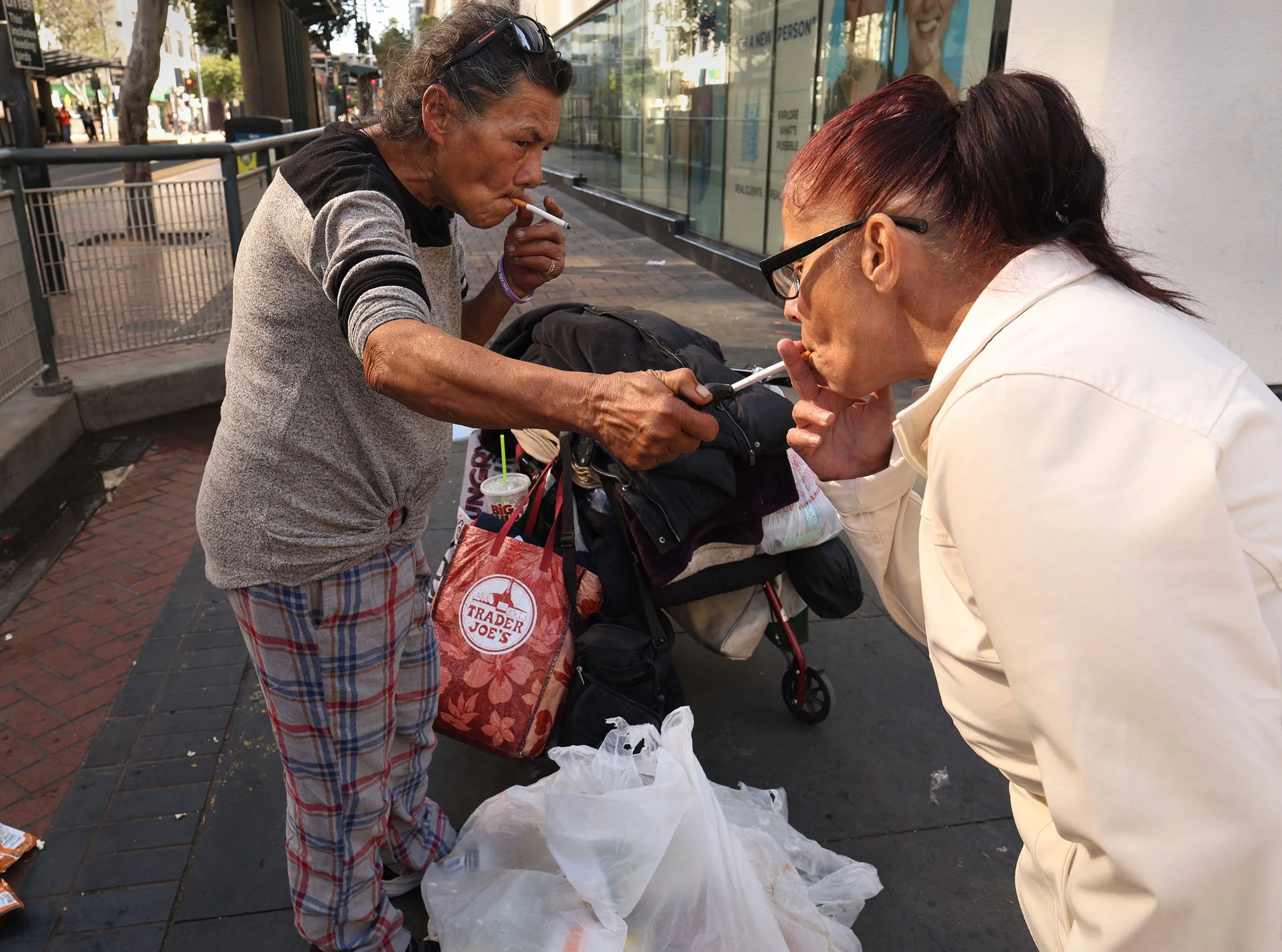
Kelly takes showers at a women’s shelter though she doesn’t think the people working there even like the people they are supposed to take care of. “I’ve been in shelters but the people act like they’re so bothered by you being there. I kept wondering ‘how can you have a job like this, and have absolutely no empathy?’ And the cops, they’ll arrest you for sleeping past 5:30 in the morning.” Ever-conscious of safety, Kelly chooses her friends carefully. “A woman needs women friends. The guys, most of them just want to get laid, and some of the women they just want to fight you. So you have to ‘mob up’ for safety. I have friends who’ve gotten raped, beat up... but there are good people out here too,” Kelly said. “When you’re asleep, it’s like you get punished for being asleep. The other homeless steal your food, clothes, blankets, anything electronic, and especially prescription drugs. You work so hard to get the drugs you need and they just take ‘em. You feel so defeated.”
In 2018 she relapsed because of intense pain in her back. Getting older and sleeping on the sidewalk tend to wreak havoc on one’s joints, she said. She gets headaches and knee pain, has fibromyalgia, diabetes, and anxiety. “M30s are the only thing that worked for me (meth),” she confessed. She’s been in the hospital for asthma and COPD, and intubated for bronchitis. She thought she was going to die several times. She also has arthritis, tendinitis, neuropathy, sciatica, and a lumbar spine injury from when her husband shoved her against a tree. She said she has what is known as DSMG, a conglomeration of mental health issues. But Kelly is a fighter. She used her personal background and experiences with getting sober on and off to earn herself a certificate in AODS, Alcohol and Drug Substance counseling, at San Diego City College. “You have to meet people where they are,” she said. “You have to have empathy.”
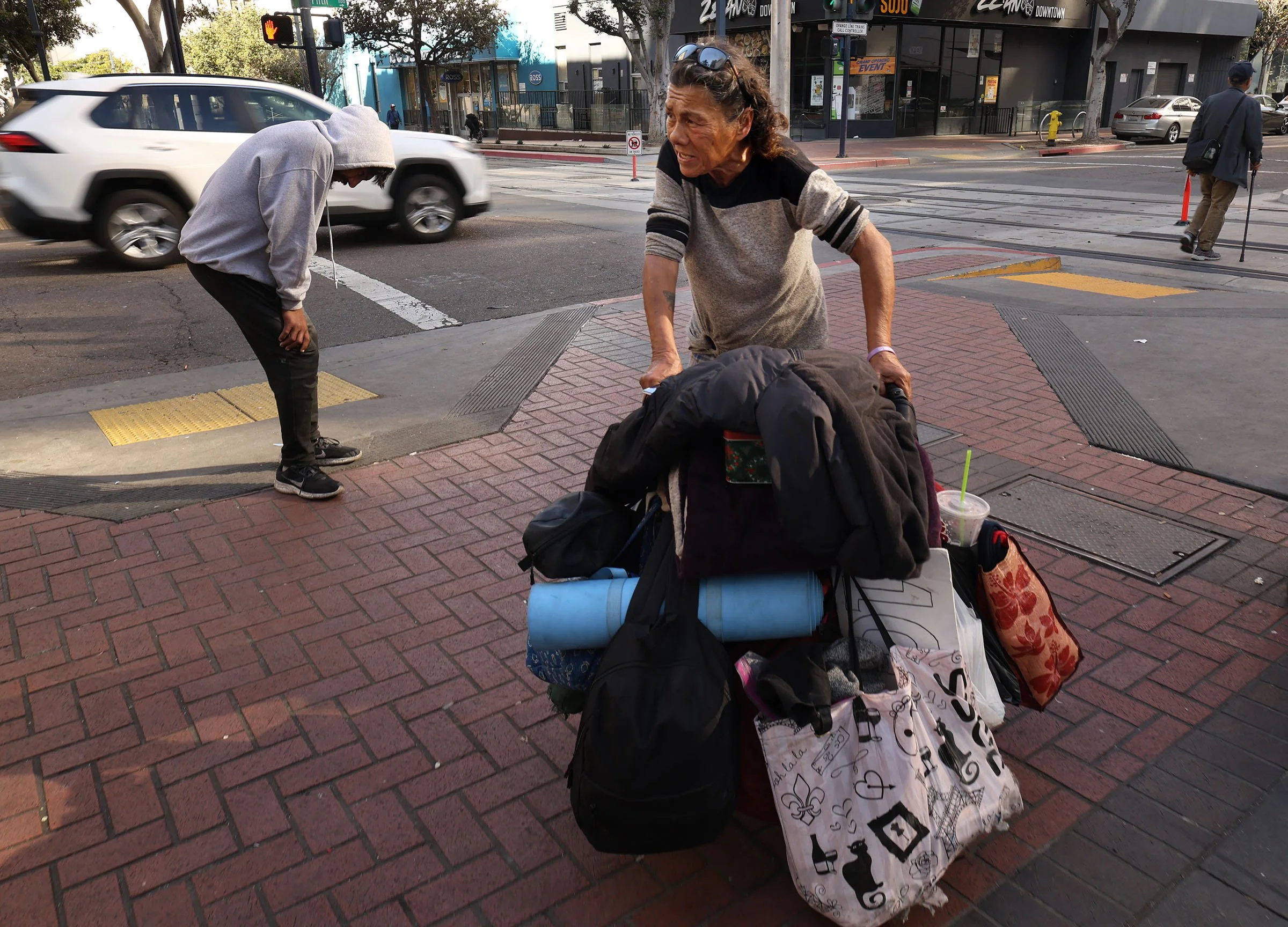
The one thing that is hard to manage while living unhoused is her type 2 diabetes. Because so many of the meals given out by churches and outreach groups lean heavily on carbohydrates, she tends to not eat much. When I asked about hygiene, she said she really hates to brush her hair. The dry shampoos that are part of donated hygiene packets leave a sticky residue that she doesn’t like. She also hates brushing her teeth “I’m losing my teeth anyway,” she laughed, “so what’s the point?”
She doesn’t suffer open wounds herself, but she has friends that suffer from what is known as 'feti leg’ - an overuse of fentanyl that causes a person’s legs to swell due to lack of circulation and build up of water. This creates an environment in which open sores don’t heal. “People die from that, or lose a leg,” she said. Despite the severity of something like feti leg, she understand people not seeking medical help. Kelly hates to go to the hospital herself because “every time you go to the hospital you lose your stuff. It makes you not want to go. It’s bad enough having to survive out here, and then you’ve got to worry about people stealing from you.”
When she is out during the day walking the streets, she likes to stop and talk with both housed and unhoused residents of San Diego. Most unhoused people just want to know what you might have that they can have, she said. “I want to talk about spirituality, about how they got here, and do they have a plan to get out of here (homelessness).” Her own plan includes finding a real apartment, with two bedrooms and an upstairs. She has a case worker, she said, but she recently lost her phone so she doesn’t know how he can contact her. She does have some money coming in from social security. She worked for many years as an accountant and office manager for a plumbing company and they had great benefits. She loved the work, and when the company was bought out by a larger plumbing company, they downsized and she lost benefits, but at least she earned enough over those years to have paid into social security, she said.
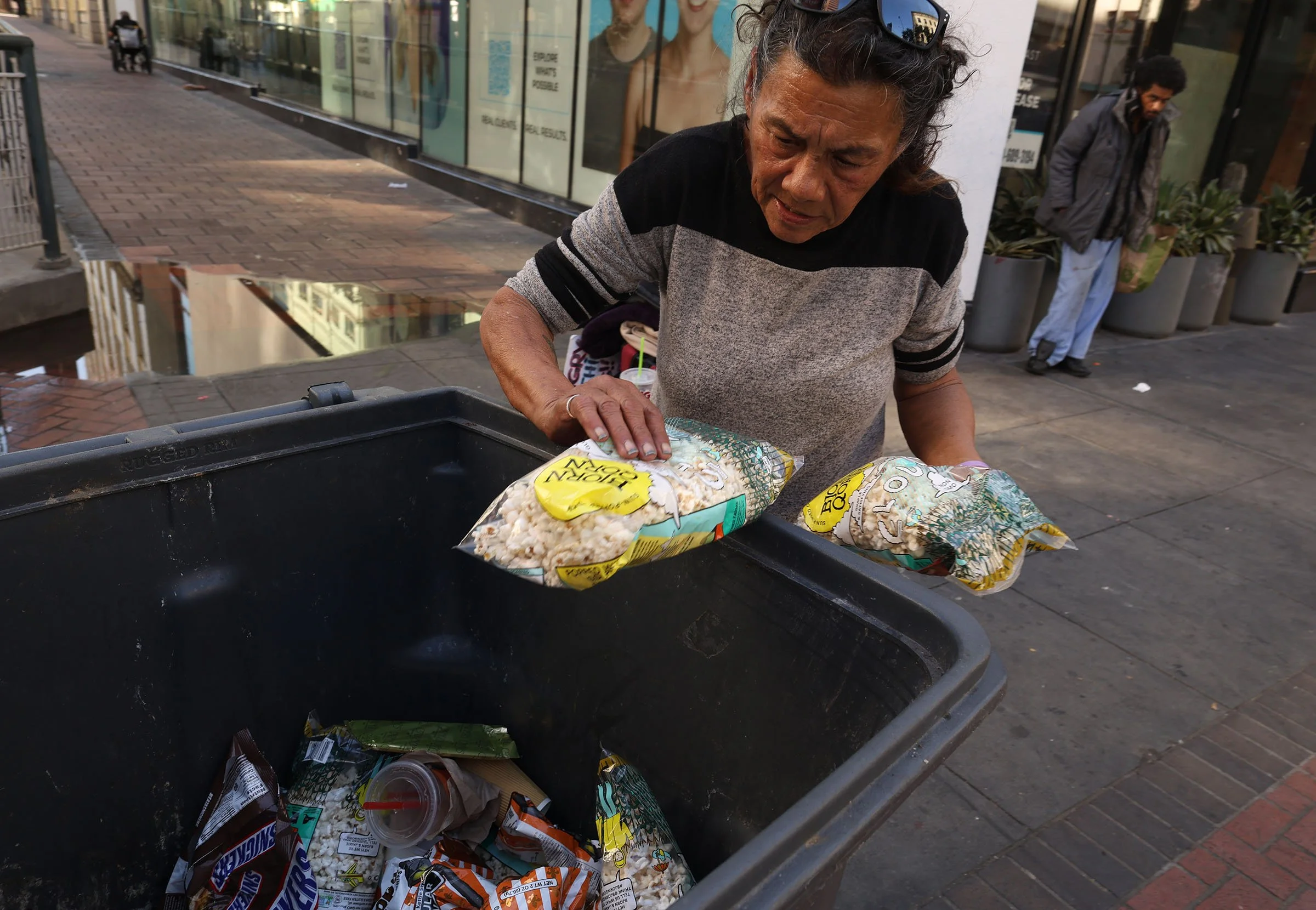
Kelly earns $30-60 a day “flying a sign” at the end of the 163 freeway where it meets city streets. That gives her enough for feti and cigarettes. As we come to the corner of B street and 6th, a man stops Kelly to mention that there are bags of popcorn in a trash can near the trolley tracks. So we head that way. Kelly angles her overflowing cart to navigate through small gatherings of very high young men, and over bumpy crosswalk ramps. Sure enough, a random trash can with the lid open has an abundance of packaged popcorn and Cajun-style kettle corn. Kelly stops to ask a man who is doubled over in pain what is wrong. He mumbles that he is in withdrawals. She apologizes that she doesn’t have anything to help him. A security guard wanders over to see what we are doing. Rather than feeling the need to explain herself, as some people might, Kelly asks him for a cigarette, which he doesn’t hesitate to offer. Curious folks start to gravitate towards us, and Kelly tells them to help themselves, while she fills a clean trash bag with as many of the bags of popcorn she can collect. She tosses her stash on top of her cart and we move on.
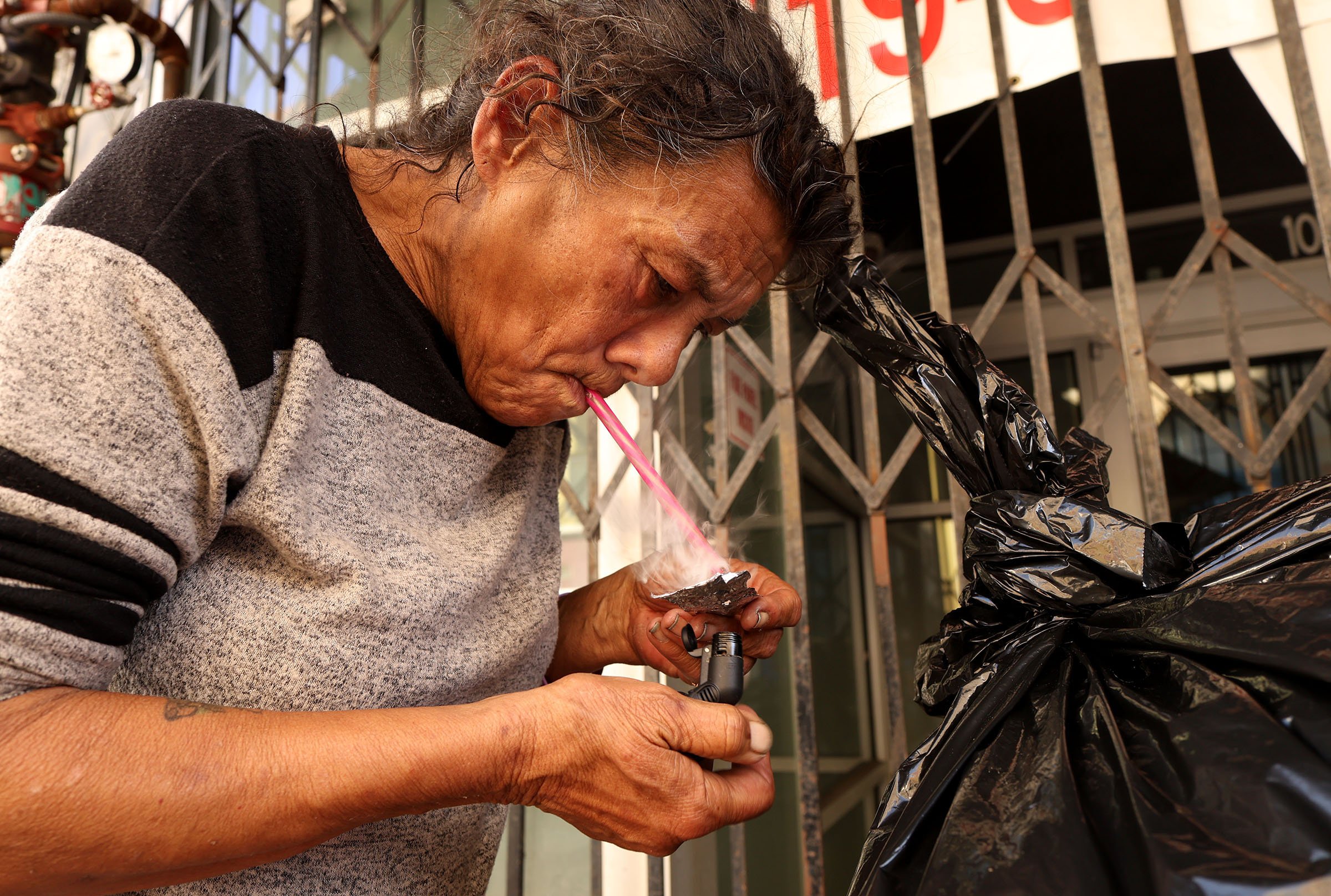
We stop in front of a vacant storefront with an iron gate across the entry way. A painter is punching in the gate code, ignoring us as Kelly takes out a straw and carefully unfolds a piece of foil holding her remaining fentanyl. “Some drugs you are not supposed to do alone,” she comments. “Like LSD, you should always have back up. And fentanyl. My daughter OD-ed six times, and nearly died. I keep NARCAN in my purse. You never know. Guys like that one in withdrawal back there, you can tell they’re in trouble because of their ‘J-cat” behavior,” she said. “They might be rolling around on the ground, waiving their arms, walking into traffic, talking to themselves. You can tell.” About $10 will buy her a bag that has enough feti to last 1-2 hours. But since she has a tendency to share, her drugs never go as far as she would like. These last two hits of her supply are not enough to really get high, only to get a buzz. “It just dulls the pain of the sciatica shooting down my back and legs. It doesn’t even take all the pain.” She dreads withdrawals. She said the diarrhea, anxiety and other symptoms are no picnic.
“The meth in the 80s was much better,” she said as we walk to the corner store for snacks and a soda. “Now it just makes you horny and paranoid. A lot of men get horny and the women get paranoid that their men are cheating on them. I’m always getting hit on. They don’t want to hear ‘no.’ Even when I tell them my fiancé just died, they say, ‘Oh this will make you feel better.’ I just ask them ‘You’re that desperate?!’ When you snub them then they try to make you feel guilty for not being with them. I really like my women friends.”
After a few moments of silence, Kelly reflected on her parents (mother and step-father). “I miss my parents. If they were still alive, I wouldn’t be homeless. They were good people.” She does have a few good memories of her birth father. He was an anti-establishment free spirit from the 60s, she said. She described him as an artist, drawing and painting free hand mostly. When she was 14, she and her dad hitch-hiked to Alaska. “It only took us two rides!” she said. One that took them into Canada, and the other from Canada to Alaska. They were staying in the woods up there, and he would disappear for days at a time. When he came back one time, “he back-handed me.” At that point Kelly called her parents and they sent her a plane ticket to come home to San Diego. Her parents wanted her to return to school, but she had had a taste of freedom from the norm, so she ran away to live with her boyfriend, which began her cycle of abusive husbands, children, alcohol, drugs and sobriety. Looking back, she said she is quite comfortable alone these days. “Men are so needy,” she laughed.